MISSION - WHY WAS THE PROJECT CREATED?
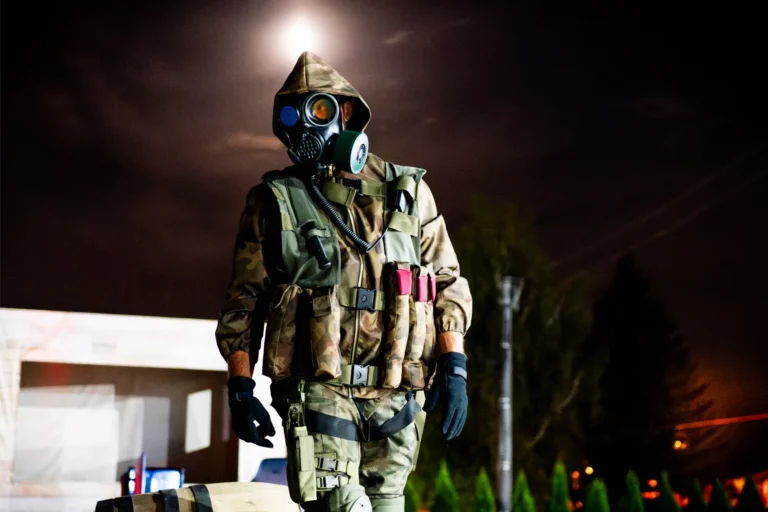
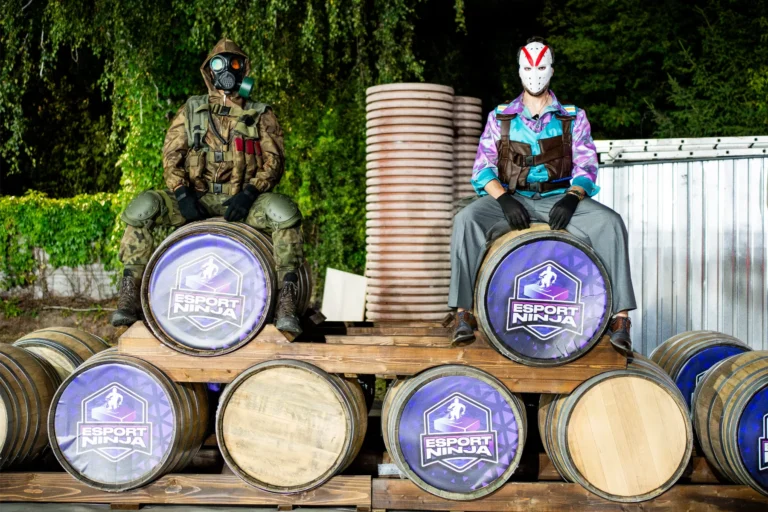
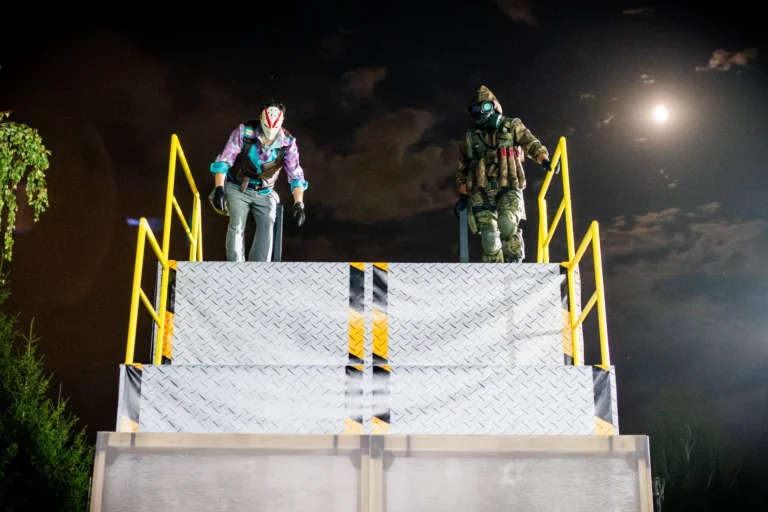
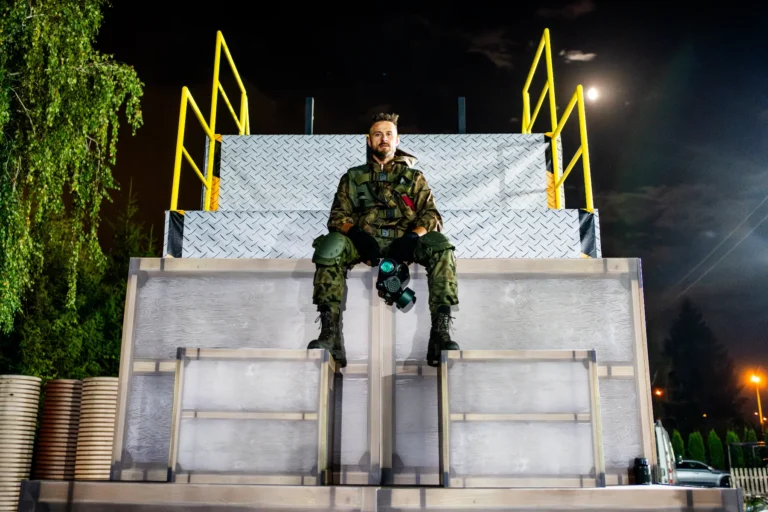
ESPORT NINJA is the first event of its kind in the world, with a mission to break down the barriers between esports and traditional sports. It creates a unique experience full of excitement and competition, merging the digital world with the real one into a dynamic challenge open to everyone – regardless of age, passion, or generation.
An innovative obstacle course inspired by CS2 maps, together with live esports competitions, brings the emotions of gaming directly into reality. This project changes the way gaming is perceived, proving that games can go hand in hand with sports. ESPORT NINJA breaks stereotypes and redefines gaming by investing in health, physical activity, and character development as the foundation for the future.

ABOUT THE EVENT – WHAT’S BEHIND THE NAME?
Competition in ESPORT NINJA is a unique fusion of sport and esports, where the emotions known from the screen are brought directly into the real world.
Each participant has about 2–3 minutes to take on the full challenge – where time, precision, and resilience against fatigue all matter:
START
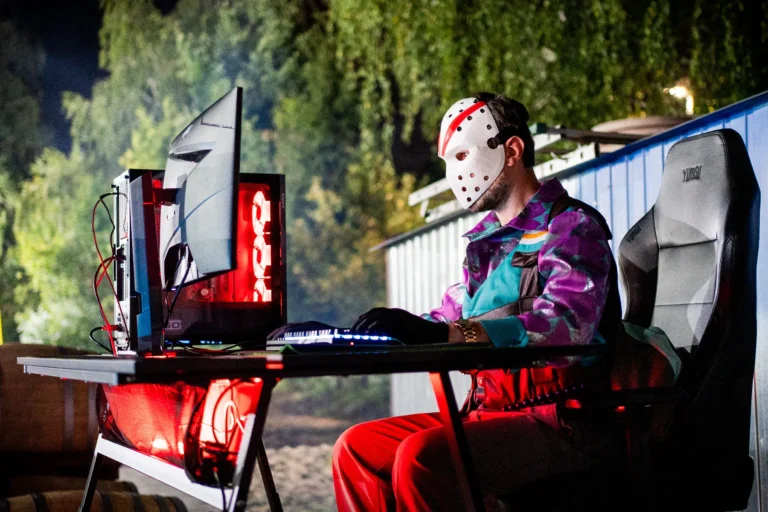
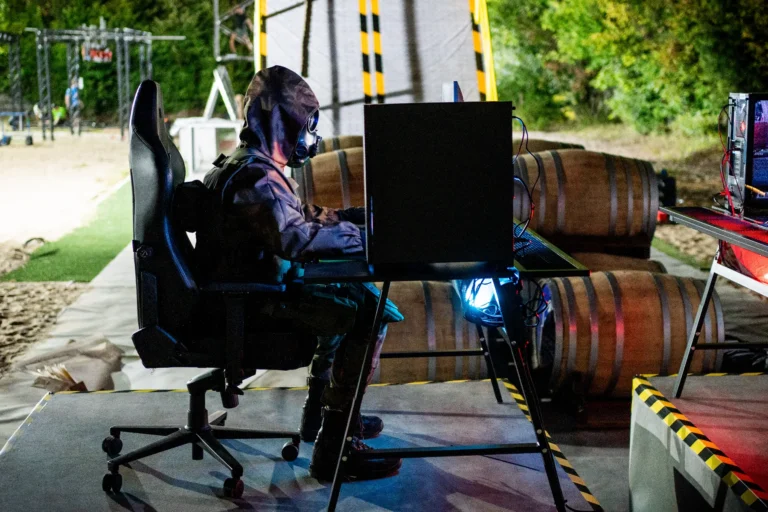
Esports Challenge: a test of reflexes and hand–eye coordination that kicks off the competition.
The goal is to achieve 30 eliminations in the shortest possible time – only lightning-fast reflexes will allow you to outpace your direct opponent.
OBSTACLE COURSE
Sports Challenge: a dynamic sequence testing speed, agility, and cleverness through eight obstacles inspired by legendary CS2 maps: the window (de_mirage), barrels (de_inferno), ramp and tunnel (de_nuke), crates (de_dust2), ladder (de_nuke), and more.
FINAL
Esports Challenge: another test of reflexes and accuracy, performed under fatigue, to reveal who can stay focused until the very end. The goal is to achieve 30 eliminations in the shortest possible time.
This is an intense race against the clock, where every move and every second counts. Participants compete for the best results in a ranking system that rewards reflexes, precision, physical ability, and stress resistance. Points contribute to both individual and team classifications, with an additional system of penalties and rewards to amplify the excitement and push engagement even further.
Thanks to this format, participants discover the difference between precision and reflexes “fresh” versus when tired. This combination reveals the true challenge – who can remain sharp not only at the start, but also when the heart is racing and the mind is working at full speed.
OBSTACLES – SPORTS COMPETITION
1. window jump
~5s
Inspiration: On maps such as de_mirage, de_inferno and de_dust2, players must pass or jump through windows.
Task: The participant must pass through a window placed at a height of 0.8 m. The height is designed to trigger different jump, step, or descent techniques, with the aid of a smaller crate (0.5 m) for support if needed.
2. Sprint Through Barrels (Rush “B”)
~10s
Inspiration: “Rush B” is a classic gameplay strategy where the player/team rushes toward the B site.
Task: A short section of the course forcing the participant to move quickly through obstacles — in this case, barrels (6 × 0.9 m) inspired by de_inferno.
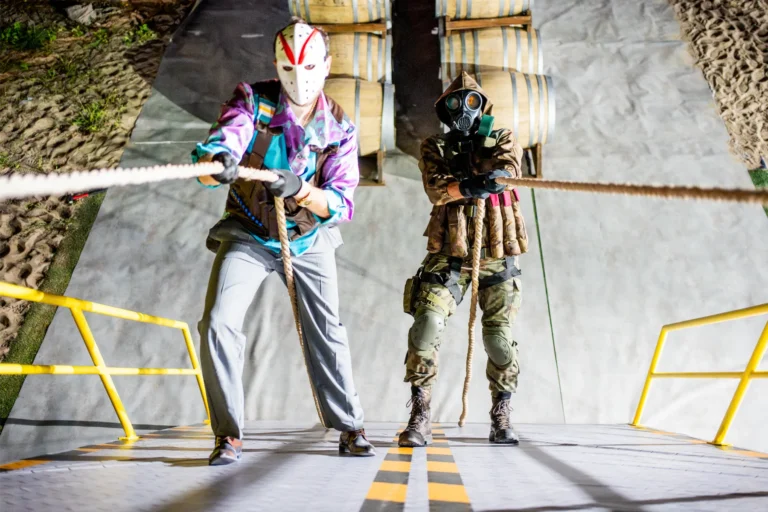
3. Ramp Climb with Rope
~10s
Inspiration: Maps like de_mirage or de_train feature ramps leading to higher ground that must be climbed.
Task: The participant must overcome an upward-sloping ramp (4.0 m), requiring proper climbing technique and adding an arm-strength challenge.
Note: Alternatively, the obstacle can be bypassed via a balcony. Participants under 15 years old are required to use this method. In this case, 20 seconds are added to their total time, ensuring all participants are ranked together. Participants aged 15+ may choose their preferred method.
4. Crate Descent (Crate Jumping)
~10s
Inspiration: Crates are common map elements, especially on de_dust2 and de_inferno.
Task: The participant must descend through 3 crate levels (3 × 1.0 m).
5.Vent crawl
~10s
Inspiration: Narrow ventilation tunnels, like those on de_nuke, are used by players to surprise opponents.
Task: The participant must crawl through a 1.0 m narrow tunnel, either crouched or on all fours.
6. Pull the crate
~10s
Inspiration: Crates, a frequent feature of maps like de_dust2 and de_inferno.
Task: The participant must pull a crate over a 5 m distance on a horizontal plane using arm strength.
7. balance bridge
~5s
Inspiration: On de_anubis, players cross narrow passages known as “bridges.”
Task: The participant must walk across a narrow L-shaped balance beam, maintaining stability throughout.
8. Vertical ladder climb
~10s
Inspiration: Maps like de_nuke and de_vertigo feature ladders that players must climb.
Task: The participant must climb a ladder (2 × 2.5 m), positioned to demand extra arm strength and dexterity.
CS2 – ESPORT COMPETITION
During the test, the participant’s task is to achieve 30 eliminations in the shortest possible time.
The sports category “silver” (up to 14 years old) completes the e-sports challenge once (at the beginning of the competition), while the sports category “global elite” (15 years and older) completes the e-sports challenge twice (at the beginning and at the end of the competition).
If a participant fails to reach 30 eliminations at the e-sports station within 1 minute, they continue the race but are each time given an additional 60 seconds added to their total time.
DLA UCZESTNIKA
Dwie formuły rywalizacji
Rywalizacja została podzielona na dwie formuły, różniące się poziomem trudności przeszkód:
FORMUŁA "SILVER"
dla uczestników rocznikowo do 14. roku życia,
Młodsi zawodnicy realizują tor biegowy w wersji z uproszczeniami.
Nie pokonują:
- przeszkody nr 3 – rampa w górę z liną,
- przeszkody nr 4 – kompletu skrzyń transportowych do zejścia w dół,
- przeszkody nr 8 – pionowej drabinki na kontenerze.
Zamiast powyższych przeszkód stosuje się przeszkody zastępcze – uczestnik przechodzi trasą z ułatwieniem (przez balkon rampy).
Do czasu końcowego doliczane jest 20 sekund.
Konkurencja esportowa odbywa się 1 raz – na początku rywalizacji.
FORMUŁA "GLOBAL ELITE"
dla uczestników rocznikowo od 15. roku życia.
Starsza kategoria rywalizuje na pełnym torze przeszkód.
- każdy uczestnik pokonuje wszystkie elementy,
- w przypadku rampy (przeszkoda nr 3) istnieje możliwość wyboru ułatwienia (jak w formule „Silver”) – wtedy do czasu końcowego doliczane jest 20 sekund,
- zawodnik samodzielnie decyduje, jak pokonać przeszkodę.
Konkurencja esportowa rozgrywana jest 2 razy:
- na początku toru,
- na końcu rywalizacji – aby sprawdzić refleks i precyzję zarówno „na świeżo”, jak i „po wysiłku”.
- UWAGA: w przypadku nieuzyskania 50 eliminacji na stanowisku esportowym w czasie 1 minuty, uczestnik kontynuuje bieg (jednak otrzymuje każdorazowo dodatkowe 60. sekund do czasu ogólnego uczestnika).
Tor i konkurencje
Każdy uczestnik mierzy się na z przeciwnikiem w rywalizacji na jednym z dwóch torów, która obejmują:
- 1 konkurencję sportową – 8 przeszkód sportowych,
- 1 konkurencję esportową – grę koordynacyjną „oko–ręka” przy stanowisku komputerowym.
Kategorie wiekowe
Obowiązuje podział na trzy rocznikowe grupy wiekowe:
- 10–11 lat
- 12–14 lat
- 15+ lat
Podsumowanie
Dzięki podziałowi na formuły i kategorie wiekowe każdy uczestnik – niezależnie od wieku i doświadczenia – ma równe szanse i możliwość przeżycia pełnych emocji zmagań. Połączenie 8 przeszkód sportowych i wyzwań esportowych „oko–ręka” gwarantuje intensywną rywalizację, w której liczy się czas, precyzja i odporność.
jakim typem gracza jesteś?
Odpowiedz na pytania i dowiedz się, jaki sprzęt najbardziej pasuje do Twojego stylu!